
What Your Garage Door Is Trying to Tell You
Most Manteca homes date to the 1960s-70s boom, and original hardware tells on itself through sound.
Read moreManteca homes built mostly in the 1960s and 70s still run original torsion springs. Here's what a cold snap does to old steel, and what to check now.
Local detail
Manteca falls in a moderate-heat climate band, so most people here think about the garage door baking in July, not freezing in January. That's backwards. The real stress on a torsion spring isn't the long summer heat, it's the sharp overnight drop on a winter morning when steel that's been sitting loaded for fifty years suddenly contracts. Housing in this service area runs from 1938 up through 2010, but the bulk of it, including most of the neighborhoods we get called to, went up in the 1960s and 70s, with a median build year of 1968. That matters because a spring installed when a house was built in 1968 has had five or six decades of cycling, and cold is what finally finds the weak coil. It's not that Manteca gets brutally cold. It's that the swing from a mild afternoon to a cold overnight low is enough to take a spring that was already near the end of its life and snap it. If your house sits in one of the older pockets of town, that's the spring doing fifty years of work on a morning it finally can't handle.
The area
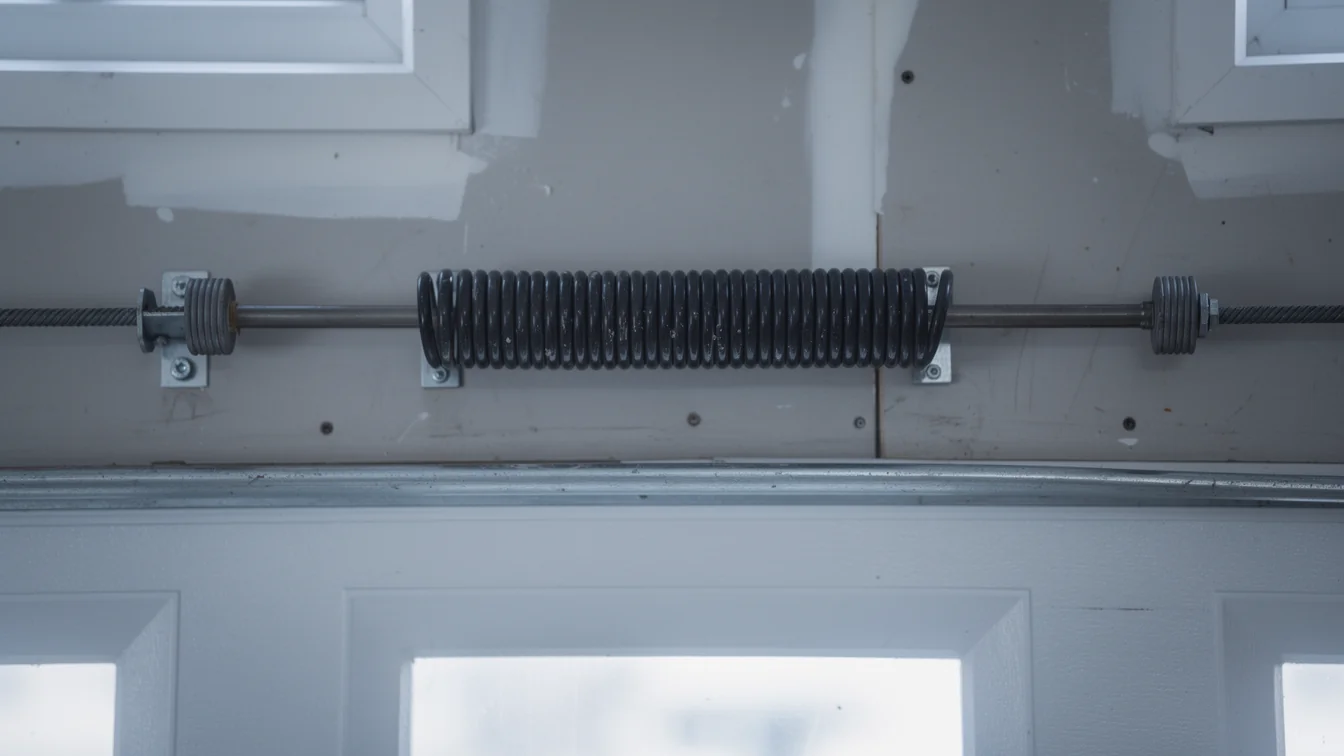
Start by looking at the spring itself, not the opener. On a double door you'll usually see two torsion springs above the door on a shaft; on some older single doors it's one spring, sometimes a pair of extension springs along the horizontal tracks instead. Look for a visible gap in the coil, that's a break, and you'll know it because the door won't lift or the opener strains and reverses. Short of a full break, check for rust pitting on the coils, flat spots where the wire has worn against itself, and any stretching, a spring that's lost its tight, even wind is close to done. Check the cables on either side of the bottom bracket too; cold makes fraying cable ends more brittle, and a cable that lets go under spring tension is its own separate problem. If the house is original to its build era, the spring may be original too. That's a 50-to-60-year-old part asking to be replaced before it decides the morning for you.
What we find
Steel loses some of its flex as it gets cold, and a torsion spring that's already fatigued from decades of daily cycling has very little flex left to lose. Across the 39,446 owner-occupied houses in this service area, most built in that same 1960s-to-70s window, a large share of them are still running the spring that came with the house. A spring under tension, wound tight every time the door closes, is already working near its limit on an ordinary day. Add a cold morning and the metal that would normally flex just enough to absorb that tension instead cracks at a stress point it's been carrying quietly for years. This is why spring failures cluster on cold mornings even in a place that isn't known for harsh winters. It's not the cold alone, it's cold hitting metal that was already near the end of its service life. A newer spring on a newer door doesn't see the same failure rate, because it hasn't had fifty winters to wear down.
How we work
If your spring hasn't broken yet, a visible gap, rust, or a flattened coil is reason enough to get it swapped before a cold morning does it for you. A door that still opens and closes smoothly, with coils that look even and tight, can wait. We won't tell you to replace a spring that's doing its job just because the house is old. That said, we don't carry every spring size and wind on the truck. Some less common torsion sizes need to be ordered, which can mean a day or two wait if yours isn't a standard fit. Median household income across this area runs $86,875, and most people here would rather spend ten minutes checking the coils themselves than pay for a job they don't need yet. If the door is slow, uneven, or the opener strains to lift it, that's your sign the spring is already past checking and into replacing.
Questions
Manteca doesn't get the kind of deep freeze that some regions do, but overnight temperature drops still stiffen steel. Combined with a spring that's been cycling since a house built in the 1960s or 70s, that cold snap is often what finally breaks a coil that was already near the end of its life.
If your house was built in that 1960s-to-70s window common across this area and the spring has never been replaced, it's likely original. Look for rust pitting, uneven coil winding, or flat-worn spots, those are signs of age the house's build year alone can't tell you.
You can, but a spring that snaps while the door is in motion can drop the door hard or damage the opener. If you're already seeing rust, a stretched coil, or strain on lift, it's cheaper and safer to replace it on your schedule than on its.
Recommendation
More garage door guides for Manteca homeowners.
Most Manteca homes date to the 1960s-70s boom, and original hardware tells on itself through sound.
Read more
When the power goes out in Manteca, your garage door opener stops working too.
Read more
Manteca's housing stock runs 1938-2010, median year 1968 - before current insulation codes.
Read moreReady when you are
Manteca Garage Door Pros repairs and installs garage doors, springs and openers in Manteca, CA and the surrounding area.